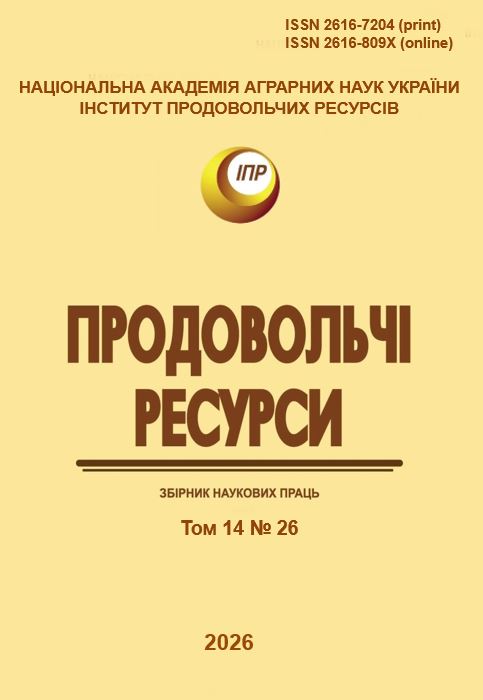
TRADITIONS OF USING AND PROCESSING FRUITS AND BERRIES IN UKRAINIAN FOOD CULTURE
DOI:
https://doi.org/10.31073/foodresources2026-26-09Keywords:
canning, dryingAbstract
Subject. Fruits have always been and remain an indispensable part of a balanced diet, providing the body with important nutrients, vitamins and energy. They are an integral part of Ukrainian food culture and have deep roots. Fruits and berries not only provided the population with nutrients but also became an important element of ritual and symbolic practices. Traditional methods of storing and processing fruits – boiling, soaking, drying – have not only been preserved, but have also become the basis of modern innovative technologies. Over time, these methods have not disappeared, but have transformed, preserving their authenticity and at the same time adapting to new technological realities. They have become the basis for the development of industrial processes, and today they are integrated into modern innovations. Purpose. Research into the formation of traditions of fruit and berry nutrition among Ukrainians, the features of the use of fruits and berries in everyday and ceremonial culture, as well as an analysis of the evolution of methods of their storage and processing. Methods. A complex of general scientific and special methods was applied, in particular, an analysis and generalization of scientific sources was carried out to systematize information on traditional and modern technologies for processing fruits and berries. Results. Traditional storage methods – pickling, drying, canning, jams and jellies – are being transformed into modern products with increased nutritional value: probiotic fermented vegetables, organic juices and compotes, freeze-dried fruit and berry snacks, craft jams and purees. The use of the latest processing technologies, modern packaging and quality control allows preserving biologically active substances, increasing the safety and competitiveness of products in the domestic and international markets. Scope of results. The practical significance of the study lies in the possibility of using its results in the activities of food industry enterprises, craft and farm production, restaurant establishments, as well as in the field of gastronomic tourism and the popularization of Ukrainian culinary heritage.
Downloads
Downloads
Published
How to Cite
Issue
Section
License
Copyright (c) 2026 Т. М. Левківська, О. В. Дущак

This work is licensed under a Creative Commons Attribution-NonCommercial-NoDerivatives 4.0 International License.
Licensing and Copyright
The collection provides immediate open access, ensuring that the content is freely available to the global community, facilitating a broader exchange of knowledge in accordance with the principles of open science.
By submitting an article to the editors of the collection, authors confirm that the manuscript has not been submitted to other publications and grant the journal the right of first publication in accordance with the terms of the Copyright Transfer Agreement.
Copyright. Authors retain full copyright to their articles without restriction and simultaneously grant the journal a non-exclusive license for publication, distribution, and indexing.
Licensing. The collection publishes articles under a Creative Commons Attribution-NonCommercial-NoDerivatives 4.0 International (CC BY-NC-ND 4.0) license.
https://creativecommons.org/licenses/by-nc-nd/4.0/deed.uk
This license permits:
- copying and distributing the material in any medium or format;
- use of the material for educational and research purposes.
- Subject to the following conditions:
- attribution of the author, source, and license link;
- noncommercial use;
- no distribution of modified material (no derivatives).
First Publication Rights. Authors grant the collection “Food Resources” first publication rights, these allowing the collection to distribute the scientific material with attribution of authorship and the original publication in the collection.
Self-Archiving. Authors may upload any version of their articles (preprint, postprint, or published version) to institutional, disciplinary, or personal repositories without embargo, provided they indicate that the article was published in the collection "Food Resources" and include the CC BY-NC-ND license.
 ISSN
ISSN  ISSN
ISSN